Ladies and gentlefops, I'm very excited to announce that my first novel, Dr. Bird's Advice for Sad Poets, will be published in March 2013 by Houghton Mifflin Harcourt. Be sure to put my book on your Goodreads "to read" list.
I warn you now that I will be promoting the pigeon-poop out of this book over the next year. I appreciate those of you who are already excited and hope to attract more and more fans as the months progress, so share this blog, share the updates, share your love.
The following updates will occur between now and launch day, to keep you all interested in my wondrousness:
--a cover reveal!
--an official website featuring my giant face!
--an awesome website feature specifically designed to make you laugh AND kill time!
--more things I can't mention yet!
What's the deal with the title, you ask (infected with precious curiosity)? Yes, some of you may remember this book by it's working-title YAWP! The change was NOT something I resisted and I am actually more excited about this title than YAWP!.
This new title meets the following 5 criteria:
It's awesome. More awesome: I can refer to my book as DR BIRD.
I'm doing a signing with Dr. Bird tonight.
Photo caption: Me and Dr. Bird, chillaxing with some lemonade.
It's easier to understand when someone says it, whereas I found myself repeating "Yawp" three times when people asked for the title. Even then, I was often met with the classic "I'll never understand what he's saying so I'll just nod" head-nod.
It'll be easier to remember, which means booksellers will not have one of those sad conversations at the information desk that goes like this:
CUSTOMER: "Do you have a book called Yelp?"
BOOKSELLER: "Doesn't look like it."
C: "It's by Evan Rosco."
B: "Spell that?"
C: "R-O-S-C-O. I think. I'm not sure."
B: "Don't see it."
C: "It's got a blue cover, I think."*
B: "Sure, let me just search our cover color database...oh wait, that doesn't exist."
C: "Can't you read my thoughts?"
B: "Not yet...."
*FYI: the cover is NOT blue.
It's still my title, as it was part of a brainstorming session that my brain cordially invited me to attend. I'm happy that I was able to come up with a good title myself, not because I don't trust my editor or her team, but because I pride myself on titling things. (This is not a joke but something of a character flaw. I love titling almost as much as I love making up songs while I do mundane things:
Sung to the upbeat 'scaramouche' section of Bohemian Rhapsody: "I am a very very hungry little man. Got to eat, got to eat, should I make myself a sandwich? Peanut butter Jelly, very very tasty me!"
It highlights a feature of the book that brings me the most joy and seems to intrigue people to read: a pigeon.
A phenomenal, gut-wrenching book about a monster that comes to a boy not to scare him, but to tell him three stories. The boy, Conor, needs the stories, but "stories are the wildest things of all" the monster says. They will not be simple.
It's impossible to say more about A MONSTER CALLS without ruining it except to say that buying the physical book -- a beautiful hardcover with amazing illustrations -- is necessary. It's a heavy book with a sad, strong story.
Historical fiction always worries me. I love learning about different places, different times, different political systems, etc, but I don't like reading history disguised as fiction. Nor do I think fiction should be shackled by historical accuracy. Don't sacrifice a good scene because it didn't happen that way in real life. And don't excuse bad storytelling because that's how it DID happen.
Kathryn Kopple's forthcoming novel LITTLE VELÁSQUEZ never left me feeling like I picked up a book from the wrong section of the bookstore. Velasquillo, the heart of the novel (but certainly not the the only character we get to know intimately), emanates a charm and loneliness throughout the novel. These two qualities are not just interesting because of his character -- though he certainly crystalizes very quickly and remains true and real throughout -- they are qualities that tie the various people in the novel together.
This novel focuses on the court of Fernando and Queen Isabel of Castile (you know, the one that funded Columbus, expelled the Jews and Muslims, and probably yelled at adorable kittens in her free time). Velasquillo manages to trick his way into being the court fool and the novel happily doesn't stick only to his POV. We're inside the heads of Isabel, her Marquesa de Moya, her daughter Juana, and others. This is key, because it shows just how pervasive loneliness is. This novel isn't simply about the loneliness of power. It's human disconnection. It's an exploration of how, at various levels in society (perhaps today's, but at least in the society of the novel), people are disconnected, unable to communicate, easily fooled, and easily fail.
Constructed to cover the ten year siege of Grenada, one might feel like time moves a bit too brisky from section to section, but Velasquillo and, to my surprise, the Queen herself, keep things connected and clear.
One of the features I enjoyed most is Kopple's sentences. She's never dry, clearly knows her time period well, but doesn't twist her words around your neck.
I leave you with this excellent passage from the prologue as evidence of how much fun this book is to read: "He didn't need a physician, didn't want one. He wanted only to be young again. How tired he was of hauling his old carcass about; so sick of the sight of wrinkles and spots. He wanted to frolic among the great, wise oaks, to urinate with glee, to feel some heat in his loins. What good did it do him to possess a body unlike any other body, one that amused and amazed, when, inside, he was no different at all--and perhaps worse off than many. He would die like any other man, in a heap of rotting teeth and flesh, with fetid breath, no less. No less.
ECHOLOCATION by Myfanwy Collins has me thinking about fission. At first I thought of the collapsing of the universe, but, without giving away too many spoilers, this is more about the collision of distinct, related women and the resulting release of energy. There is destruction and creation in the series of events. Examples of gain from loss begin in the opening pages when Geneva (the main character and the most morally compelling) loses her arm but gains freedom.
I think the greatest momentum in the novel is created by the consistent PRESENCE of the PAST. This particular aspect of the novel reminds me of Alice Munro, whose characters seem like mental time travelers, moving between now and then. Collins juggles Renee, Cheri, and Geneva and I'm curious what she'd be able to do with just one character put under the microscope of her sentences.
The closing ~30 pages is quite interesting as it reveals more memories than I expected from the climax of the novel, cementing Geneva as the emotional core of the novel, the potentially tragic figure, and the one who still lingers after I've shut the book.
Wow. I didn't intend to read this one tonight but I started and realized it was impossible to put down. There's so many ways this book could go wrong, but it manages to stay on the tracks (train metaphor!) without crashing into a mountain (plane metaphor!).
Basically, this book is HILARIOUS and gruff and a little frustrating (but in a way that makes sense and works when I sat back and considered things as a whole). The narrator is imperfect but witty; his friend Earl is phenomenal and smart; Rachel (the titular dying girl) is -- well, I can't say anything without destroying what Andrews has created here.
Suffice to say, I bought this book on a whim: GREAT cover + description that mentions filmmaking HS kids who watch Aguirre, The Wrath of God too much + great voice in the opening = winner.
I am not sorry I succumbed to the whim purchase. and now I will begin to champion this book.
This movie is messy. Both in the horror/sci-fi sense with blood and violence, but also in the plot sense. But I think the writers had some sense of what they were trying to do: hint at possibilities without being concrete. Not a surprise they wrote for Lost.
Plus, I think there are some intriguing possibilities when it comes to the plot.
Spoilers ahead. Duh.
THE OPENING
It struck me that the opening was weird -- was it a metaphor or literal? Would aliens really drop down on the surface and sacrifice their bodies to create a new life form based on their own DNA? Sure. why not. It seems pretty inefficient, but let's just accept that it's the process they tested and decided upon. who needs robots or unmanned probes.
In fact, let's not even assume that this was a scientist. Let's assume he was a religious figure. The robe hints at that. Maybe this was a guy that sacrificed himself for some grand, egotistical scheme. He believes he's a god or he wants to feel like one. So, maybe he's not left behind; maybe he sneaks away. We'll call him Engineer Zero.
And maybe when the other Engineers find out what Zero's done they have to erase his mistake. they don't want Zero's creation littering up this planet they found that could be a perfect colony.
Might the Engineers have decided to destroy humans simply because the humans were created out of vanity by a powerful, rich CEO/Scientist/Crackpot? Created just because they could be created? Or maybe the entire race created humans and then, like tossing a bad poem or smashing a lopsided clay pot, destroyed the humans because they aren't nearly as good as vanity demands?
Interesting, but not enough proof to be SURE. Plus, if my friend Mike is correct, Ridley Scott has said that the Engineers did put their DNA on earth this way. He didn't say it was a one-man vanity project. But...
Should we make the mistake and assume that the Engineers are one cohesive people? What if we think more like the human society being featured -- the one where Weyland industries as trillions of dollars to spend on a vanity project? What if an Engineer (not THE ENGINEERS) created Human Beings as a vanity project? what if there's a company or a faction of Engineers that wanted to CREATE a being; it's not the goal of the entire race of Engineers. it's a vanity project of one particular Engineer company. The Engineer Weyland Industries.
Or, perhaps this: what if humans are not a vanity project -- immortality for an individual or an entire race -- but are genetic engineered weapon project version 1.0 and the Aliens (acid drooling, insectoid Geiger aliens) are version 2.0? Ver 1.0 is "see if you can create a form of life that's purely biological, not an android. Then, Version 2.0 is see if you can create a purely biological weapon.
Or what if humans are simply created as food to feed the weapons. Create a whole planet of food and then deliver the black goop and then you've got a planet manufacturing plant and warehouse. Trouble is the weapon is too aggressive, the military base gets destroyed as they are making final preparations to deliver the goop, leaving the food source to evolve and begin assuming it's 'special' -- like a McDonald's hamburger left in the sun, gaining sentience, and convincing itself it was created for something more than becoming lodged in the large colon of a Geiger monster.
Creating life makes me feel powerful until I see that the creation is not on the same grand level as me. How sad. David even points out to Charlie: "Wouldn't you feel disappointed if you got the same response from your creator?" when Charlie says David was created just because humans had the ability to do it.
Creation for the sake of creation is a vane pursuit. It's good science to explore and experiment, but with the religious impulse of humans it will inevitably lead to the worship of science/technology and the disappointment with the creations.
The Engineers may have simply decided to destroy humans because they were too primitive. Made out of pride; destroyed out of disappointment. Humans didn't DO anything wrong.
This of course also leads us to look at why there's such an emphasis on MALE creation and the horrors associated with FEMALE creation.
ALL THE PENISES AND VAGINAS
Enough people have pointed out the psychological trauma of men being impregnated in Alien. Prometheus does not reduce the amount of gender imagery. In fact, I think it does an even better job of expanding on the idea of gender conflicts and makes a more forceful illustration of the terror men feel when they feel like they are useless. science and money and technology makes men feel useful; men hoard power because it hides their biologically temporary usefulness (men provide genetic material and then the female does the rest of the work; except with sea horses and a few other creatures. but seahorses didn't take over the planet, so clearly the female-as-baby-maker is the more successful form of reproduction).
Overall, I think the film argues supports the longstanding argument that men yearn to create life and resent the fact that females actually do 99% of the creating when it comes to human reproduction. Race of Engineers, we can assume, have the same issue. Men have power to destroy but wish they could create AS WELL. (No idea how the engineers reproduce, but since we share their DNA we must assume it's similar. not like viruses or with eggs, which is why the Alien aliens are so terrifying.)
Consider the various gender conflicts presented throughout the film:
Vickers -- daughter of Weyland, the guy that wants to live forever or at least be the man to face his creator. Vickers is resentful of male android who gets father's affection; clear that father does not respect Vickers; clear that she wishes he would just DIE already. She's a tough chick in a difficult place: she knows the agenda (her father's vanity is essentially the financial engine behind everything, including the expedition); but she also knows that the people on board the ship are a mixture of science nerds and "true believers." In fact the "truest" believer is a female, while Vickers believes the markings are the scrawls of animals (my paraphrase). Vickers would prefer in a more mundane, scientific explanation -- that there are no creators. that no creature or race would have power over humans. It would mean Vickers, once she's head of Weyland industries, would be close to a god.
Plus, isn't it fitting that the Captain asks Vickers if she's a robot and the way she disproves this is to have sex with him? her only power is her genitalia. and also that's the way she has to identify herself in a male world. I think Vickers is the saddest character of all. I feel like Dr. Shaw's challenged faith is pretty tame compared to what Vickers ends up going through. And i'm sad that Vickers gets killed as I think her journey to the stars (with or without Shaw) would've been even more telling. Does she take up her father's cause or Dr. Shaw's? Vickers and David in a ship looking for the Engineers? Now THAT's a story.
Weyland -- dude is human vanity personified. Uses all money and technology at his disposal to face his creator and is rightly murdered for it. In many ways, human stories suggest that one CAN face a creator and win: Zeus overthrows his father and then fears being overthrown himself; the stories of kings are the stories of vanity and fear of death. Even the Christian tradition allows for humans to "face" their god -- Moses and Noah, amongst a few others, get face time with God. Jesus is both god & man. So, it's not surprising that Weyland believes he will have a chance to ask questions of his god.
Sadly, he forgets the story of Job, a story that's much older than much of the old testament. Weyland also ignores the older version of the flood myth where Utnapishtim -- the Sumerian/Akkadian Noah -- is protected by one god when the other gods decide to wipe out humanity. Utnapishtim is then forced to live apart from humans because he was from before the flood. He's deemed special, but not a god. Some of the god's hate that he survived. But Job is the one that asks questions and is reprimanded. Not with death like Weyland, but intellectually: god tells Job "you do not have my creative power, you did not create the earth, the trees, the sea monsters, so how dare you presume you can question me about why you suffer!" The Engineer that whacks Weyland in the face takes less time to make the same point. (Curiously, Job gets all his stuff back and new, better looking daughters. But that's another analysis...)
Weyland deems himself powerful enough to look a god in the face; that god smacks him down (note, too, that Weyland dies of head trauma -- the head being the seat of sentience -- while David has his head ripped off of his body, essentially isolating his sentience from his body, the thing that represents his biological humanness (recall that Charlie says David has no biological processes, but even so David needs senses to analyze the world. A digestive tract? not so much.
Plus, David but does not die -- he will be able to continually explore this issue because he has no soul; Weyland says "there is nothing" and David confirms this but still says "enjoy your journey." David might actually have the potential to understand the nature of the soul, even without 'having' one.)
<image removed, but you can google it I swear!>
Fassbender as David is awesome. Just look at him all awesome there.
David -- made in "man's image" David is the obvious parallel to the creation of human beings by an Engineer. David says that despite not needing biological human processes (breathing, eating) he looks human because it makes human's more comfortable. But we know that it's not comfort but vanity. Weyland calls David his "son" who lacks a soul. David is made to look like a human. Even David has some sense of self in dying his hair and mimicking TE Lawrence as portrayed by blue-eyed Peter O'Toole in Lawrence of Arabia (a movie about an outsider in a desert much like David is an outside amongst humans in the desert of deep space).
David's gender conflict is that he has a proscribed gender (male) but no need for a gender. He is not a biological creature but is still a man. He and Vickers are perfectly at odds -- both are cold, but Vickers has one of 2 emotional moments when she slams David against the wall and demands information. (The other is when she has to torch Charlie.)
Engineers -- all male. We have no sense of female presence on the entire planet. the ship in the beginning could be called an Ova, though the military ship is a bent penis or a snake eating itself. Either way, the moon the Engineers used to create their weapons of mass destruction is masculine: tombs with male faces, a mountain peak jutting into the sky, the comment "god does not build straight lines" made by Charlie.
Black Goop Created Creatures -- There's all these hints of phalluses and vaginas here. Once the black goop begins to transform the worms in the dirt of the tomb, we get the first vagina. The worm looks sperm-like when it raises out of the black goop, but as the idiot biologist (who says "good girl" and "what a pretty girl") approaches, the sperm-like work opens up and reveals a toothed vagina (and there's that classic toothy vagina myth, of course). The worm is male AND female. Not surprising that it grabs idiot biologist, breaks his arm, and then penetrates him and impregnates him. The biologist is raped (just as the face-huggers rape the men and women in the Alien films).
Dr. Shaw -- performs an abortion on herself. There's no need to belabor the suggestions here. The machine is "calibrated for male patients only" and she must improvise. (the machine is clearly there for Weyland and not Vickers.) She suffers through a c-section of sorts, the horrible alien fetus is removed from her, and she's stapled back together. She's a modified virgin mother -- sterile but impregnated by the aliens (because the Engineers are godlike they can impregnate a sterile woman just like god impregnates the virgin Mary. if you're willing to believe that Mary's a virgin, but it seems more like she'd had sex with her husband but was IMPREGNATED without having sex. immaculate conception yes, virgin no.)
Dr. Shaw is caught in between two intriguing binaries: she's a woman, but cannot get pregnant; she's a scientist that believes aliens created humans but believes in God (or, at least, wears a cross? It's not as clear as it could be).
Oh, and David snooped on her dreams and memories while she slept (a memory rape). So, she's also the equal partner of a scientific duo with Charlie, but also under the thumb of 2 men: Weyland & David.
CONCLUSIONS
In the end, I think Prometheus is fascinating and flawed. As a movie it has great moments of tension, some astounding visuals (some "ruined" by the trailer), good music, great acting, and a reasonably pleasing set of possible interpretations. I just feel like it could be a little more on the nose about one or two things instead of being so satisfied with the "I am still searching" conclusion offered by Dr. Shaw's voiceover.
Interesting collection of quotations that elaborates on some of the vagueness.
http://www.ign.com/wikis/prometheus/Official_Quotes
"Tonight / I'm gonna have myself / a real good time." -- "Don't Stop Me Now"
Recently my wife and I stumbled upon the Palladia channel on cable and watched the second half of a fantastic Queen concert from Montreal that has been remastered sometime recently.
My wife LOVES Queen. I, too, love Queen, but not as much as her. She knows the lyrics to more than just Bohemian Rhapsody and We Will Rock You. She's certainly not a huge fan as compared to others, but in our house she easily takes the honor.
GLORIOUS.
I found myself recalling various things about Queen that I've learned throughout the years -- from Freddie Mercury's demise, to the lyrics to "Bicycle Race" (back in 4th grade, my friend's father used to sing it constantly), to the fact that Brian May can play a mean guitar. What I never considered, though, was the fact that Queen doesn't exist anymore. Or, to put it more precisely, Queen-like bands don't exist anymore. Rock music's too cynical.
Cynicism has made Queen seem dated.
(NPR even published this short piece for "Old Music Tuesday." Clearly there's something in the air.)
I don't mean in the "Queen sounds too naive/simplistic/crappy compared to current bands." I mean there's no one else out there that tries to sound like them or can sound like them or will sound like them. They might be one of the most talented, fun, skilled, and (most importantly) successful bands ever. Yes, The Beatles had fun and their albums were ahead of their time, trippy, layered, meaningful, etc. The 60s and 70s had lots of fun music. Led Zeppelin, too. Pink Floyd. But post-Queen? Who compares?
Consider what they were: a 70s British Arena-rock band with a flamboyant frontman. They collectively wrote orchestrated songs ranging from goofy (the aforementioned "Bicycle Race") to serious ("You're My Best Friend.") "We Are the Champions" and "We Will Rock You" will forever play in stadiums across the USA, if not around the world because they are earnest anthems. They have a song about the radio ("Radio Ga-Ga") -- to be fair, so does Hall & Oats. They wrote the goddamn soundtrack to Flash, a campy sci-fi radio-show-turned-80s-movie. It was the soundtrack Queen was born to record.
They are one of the few bands I can think of that takes being not-serious, seriously. And can still be serious when they want.
Think about the arena-rock bands that have followed them:
Journey -- big music. didn't take themselves too seriously. Steve Perry has a tremendous voice and they made an intentional shift in songwriting in the late 70s to embrace a more commercial sound, resulting in their "peak" performance albums Escape and Frontiers.
Def Leppard -- terrible lyrics, great guitarist, decent Journey-esque singer. Hysteria sold over 12 million copies, doubling their prior album. But 2 albums of 80s-arena-rock does not compare to Queen in terms of success. Plus, their multiple hits from Hysteria don't stand up to some of the unique, iconic Queen songs.
Aerosmith (to be fair, didn't really "follow" Queen, but developed around the same time) -- American rock -- a very light Zeppelin, particularly back in the late 70s. Once they got off the drugs for a while, they were more a light Journey than anything else. Lots of hit songs; flamboyant frontman; didn't take themselves seriously. And while I dislike 99% of their catalog, they remained successful, albeit not necessarily relevant, up to the end of the 20th century. Not sure they match the skill of Queen.
Van Halen -- The less I say, the better, but this is a successful arena rock band that swings between serious and silly. David Lee Roth is an American Mercury in terms of showmanship, but he lacks the consistency and the songwriting skills.
U2 -- they take themselves very seriously, to the point where Bono's lack of lyrical prowess sounds silly in a bad way when he probably wants to be silly (from time to time) in a Queen way. (Look at the lyrics from "New York": In New York summers get hot, well into the hundreds / You can't walk around the block without a change of clothing / Hot as a hairdryer in your face / Hot as a handbag and a can of mace / In New York, I just got a place in New York." is that supposed to be funny or serious-and-thus-horrible? The song eventually talks about how the Irish came to NY as well, so I'm assuming it's supposed to be horrible.)
The so-called cock-rock bands of the late 80s are technically arena-rockers, and while they are clearly not better than Queen, they changed the landscape when it came to 'big' rock music. Could you imagine Mötley Crüe writing a song like "Fat Bottom Girls"?
Mötley Crüe started rocking in 1981 with songs like "Public Enemy #1" ("Hear the screams / Another one dies tonight") and "Come On and Dance" ("She's a leather tease / When she's on top / Well, you can't be stopped / Watch her scream / Watch her suck you clean / And you should've seen her dance.") Subtlety be damned, the Crüe will rock! (these are not the best examples of their early work, but they really don't get big for another album or two.)
Queen started 10 years prior to Crüe. In 1981, Queen released The Game, including "Crazy Little Thing Called Love" and "Another One Bites the Dust" (Vanilla Ice remembers that year well. Or, at least, the song.)
I point to Mötley Crüe not out of a person preference (I only ever owned a cassette of Dr. Feelgood); just that they are one of the biggest hair bands aside from the one band I think came close to comparing to Queen post-Queen. It's going to pain some of you (particularly my wife who breaks out into a rash when I sing this band at karaoke).
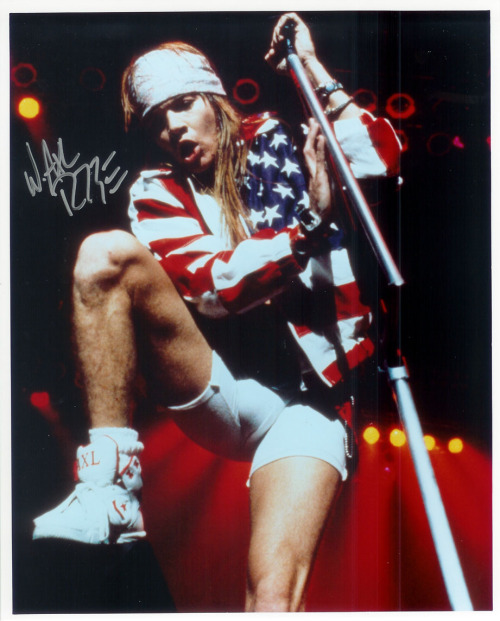
Yes, the one band I think gets close to the stage and album theatrics, the band with the flamboyant (albeit aggressively heterosexual and misogynistic) front man, the band with the total musical skill to back it all up:
GUNS
'N
ROSES
CONSIDER:
Not even his best jumpsuit.
Try not to stare at the bulge.
Seriously. Epic songs? "November Rain", "Estranged," "Rocket Queen", "Coma", "Paradise City". Crazy-good guitarist? Slash. (He's even got Brian May-esque HAIR!)
In the end, of course, Guns N Roses has a great musical range that stems from Rose's skill as a songwriter, but on the whole he doesn't have the ability to laugh at himself. (Axl DID cover a Charles Manson song and wrote lyrics like "You're daddy worked in porno / now that mommy's not around / she used to love her heroine / but now she's underground." But he's not gonna be caught dead singing "Bicycle Race," except maybe in the shower after a long night of coke and hookers. Even then, he'd probably deny it.)
Mötley Crüe has nothing on GNR, but GNR still pales in comparison to the tremendous breadth of Queen's skill and imagination and success and overall JOY.
Still, if you doubt my GnR comparison, you can't ignore this:
That's Elton John & Axl Rose singing "Bohemian Rhapsody". Maybe Axl CAN laugh at himself.
So, here's what we have: the world has moved on from true, bright, upbeat, optimistic, nearly endlessly fun rock music. For every Jet that appears, one dies.